





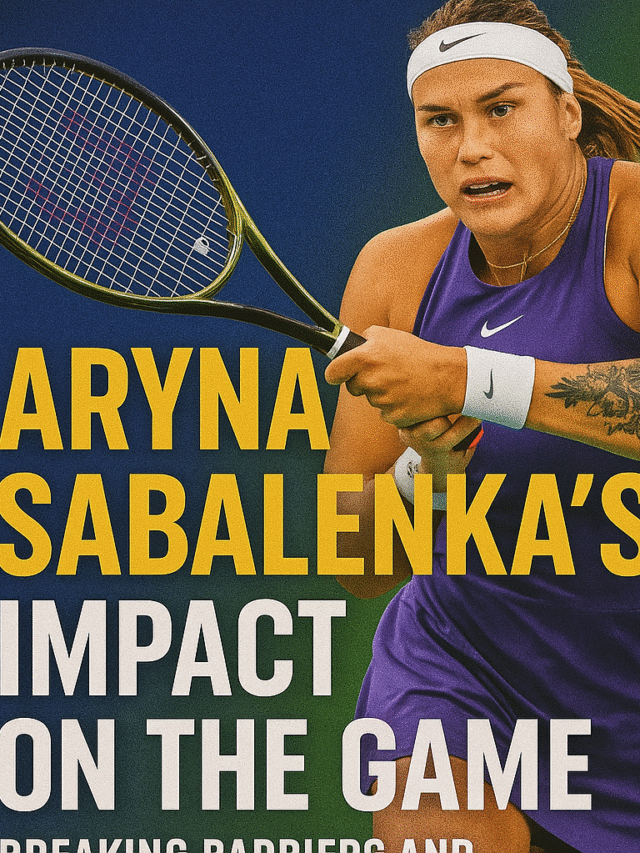


Anastasia Potapova: An On-Court View of a Star’s Fiery Ascent
The air is thick with anticipation here at the stadium, a palpable energy you can almost taste. It’s a familiar feeling, one I’ve come to associate with moments just before a major tennis match begins. My name is Mohit, and for years, my press pass has been my ticket to the front lines of the tennis world. I’ve seen legends rise and fall, witnessed impossible comebacks, and felt the collective gasp of thousands over a single, perfectly placed shot. But today, standing court-side, my focus is on a player whose presence is becoming increasingly magnetic: Anastasia Potapova.
There’s a certain electricity that surrounds players on the cusp of greatness. You see it in their walk, a blend of confidence and nervous energy. You hear it in the way the crowd’s murmur shifts when they step onto the court. With Potapova, that energy is undeniable. She carries herself with a quiet intensity, a look in her eye that says she’s not just here to play; she’s here to dominate.
Watching her warm up is a study in controlled power.
Each forehand cracks off the racquet with a sound that reverberates through the stadium
. Her backhand, a fluid, two-handed stroke, is both a defensive wall and an offensive weapon.
It’s this combination of raw power and technical skill that has made the tennis world sit up and take notice. From my vantage point just a few feet from the baseline, I can see the sheer physicality of her game. The explosive first step, the quick pivot of the hips, the full-body rotation that generates incredible racquet-head speed—it’s a dynamic display of athleticism that photos and television screens can’t fully capture. You have to be here, to feel the gust of wind as she sprints for a drop shot, to truly appreciate the force she brings to every point.

The Early Sparks of a Champion
To understand the player she is today, you have to look back at the journey that forged her. Every great athlete has an origin story, and for Anastasia Potapova, it began on the junior circuit. Even then, the signs of a future star were clear. I remember covering a junior tournament years ago, a much smaller affair than the grand stadiums she plays in now. The crowds were sparse, mostly just coaches, family, and a handful of dedicated scouts and journalists like myself.
Even in that less glamorous setting, Potapova stood out. She had a ferocity that was rare for her age. While other young players might get discouraged after a lost point or a bad call, she seemed to use it as fuel. A lost game would be followed by a service ace, a double fault answered with a blistering return winner. She had that champion’s mentality, the ability to reset and refocus in an instant. I recall a conversation with a veteran coach back then. He pointed her out to me from across the courts and said, “Watch that one, Mohit. She has the fire. You can’t teach that.”
He was right. Her crowning achievement as a junior was winning the Wimbledon girls’ singles title in 2016. I was there, in the stands at the All England Club, and the maturity she displayed on that grand stage was remarkable. She navigated the immense pressure of a Grand Slam final with a composure that belied her years. It was more than just a victory; it was a statement. It announced the arrival of a player who was not intimidated by the big moments but, in fact, thrived in them. That win wasn’t just a trophy; it was a clear signal to the professional tour that Anastasia Potapova was coming, and she was ready.
Forging an Identity on the WTA Tour
The transition from the junior circuit to the professional WTA Tour is one of the most challenging hurdles in a tennis player’s career. The level of competition is a massive leap. Suddenly, you’re facing seasoned veterans who have spent years honing their craft, players who can exploit any weakness with ruthless efficiency. Many celebrated juniors have faltered at this stage, but Potapova met the challenge head-on.
Her early years on the tour were a learning process, marked by both impressive wins and tough losses. From my press-row seat, I’ve tracked her evolution. I’ve seen her work tirelessly to add new dimensions to her game. Initially known for her aggressive baseline play, she began to incorporate more variety—the clever slice to break an opponent’s rhythm, the well-timed approach to the net to finish a point. These weren’t just technical adjustments; they were signs of a growing tactical awareness.
One match that sticks in my mind was an early-round encounter at a hard-court tournament here in the States.
She was the underdog, facing a top-20 player with a massive serve. For the first set, she was simply overpowered. It looked like it was going to be a quick exit. But then, something shifted. I watched her between sets, talking intently with her coach. When she came back on court, she had a new strategy. She stood further back to receive serve, giving herself an extra split second to react. She started using high, looping topspin shots to push her opponent off the baseline. It was a masterful tactical adjustment, and it turned the tide of the match. She battled back and won in three grueling sets.
That match, for me, symbolized her growth. It showed she was more than just a power hitter. She was a thinker, a problem-solver.
It’s this combination of raw talent and court intelligence that has allowed her to claim her place among the elite. Winning her first WTA singles title was a major milestone, a validation of all the hard work. Standing on the press balcony, watching her lift that trophy, you could see the mix of relief and pure joy on her face. It was a moment that had been years in the making, from those early days on the junior courts to that very podium. It was the culmination of a journey and, at the same time, the beginning of a new one.

The Anatomy of Potapova’s Game
Let’s break down what makes her such a formidable opponent. From my position near the court, I get an up-close look at the mechanics of her game, and it’s a compelling blend of aggression and precision.
Her forehand is, without a doubt, her signature weapon. It’s a shot she hits with immense confidence and pace. She can flatten it out for a down-the-line winner or generate heavy topspin to push her opponents deep behind the baseline, setting up her next attack. When she has time to set her feet and unleash that forehand, the point is often over before it has truly begun. The sound it makes is a sharp, percussive crack that signals pure, clean contact.
But a great player can’t be one-dimensional. Her two-handed backhand is equally impressive. It’s a remarkably solid and versatile stroke. She can absorb pace with it on defense, redirecting an opponent’s power with uncanny ease. She can also turn it into an offensive weapon, particularly her cross-court backhand, which she uses to open up the court and create sharp angles. Watching her trade backhands with other top players is like watching a high-speed chess match, each player probing for an opening, waiting for the other to flinch.
Serving is another key component. While it might not be the most overpowering serve on the tour, it is highly effective. She has a clean, repeatable motion and can hit her spots with accuracy. She mixes up her placement well, keeping her opponents guessing. Her ability to hit a clutch serve on a break point or at a critical moment in a tiebreak has saved her in countless matches. It’s a testament to her mental fortitude under pressure.
Perhaps the most underrated part of her game is her movement and court coverage. She is a phenomenal athlete, quick and agile. Her footwork is precise, allowing her to get into position for her powerful groundstrokes. She defends with a tenacity that can be demoralizing for her opponents, chasing down balls that would be clean winners against most other players. This defensive grit often allows her to extend rallies, turning a seemingly lost point into an opportunity to reset and go on the offensive. It’s this relentless spirit, this refusal to give up on any point, that defines Anastasia Potapova as much as any single shot in her arsenal.
The Mental Game: Fire and Focus
In professional tennis, the margins are razor-thin. At the highest level, almost everyone can hit a world-class forehand or a powerful serve. What often separates the top 10 from the top 50 is what happens between the ears. The mental game is where matches are won and lost, and it’s an area where Potapova’s personality shines through.
She is an expressive player on the court. You can see the fire in her eyes, the passion that drives her. A fist pump after a crucial winner, a determined shout of “Come on!”—these aren’t just for show. They are outward manifestations of her intense competitive drive. From my spot on the sidelines, I can see how she uses this emotion to fuel her performance, to keep her energy levels high through a long, grueling match. This fire is a double-edged sword for many players; it can lead to greatness, but it can also lead to frustration and unforced errors.
What’s been impressive to witness in Potapova’s development is her growing ability to channel that fire constructively. In her younger years, a string of bad points could sometimes lead to a negative spiral. But now, she has matured. She has learned to manage her emotions, to use that intensity to sharpen her focus rather than letting it distract her. I’ve watched her take a deep breath after a missed opportunity, turn her back to the net for a moment, and completely reset. This mental resilience is a skill honed through experience.
Playing in front of thousands of people, with millions more watching around the world, creates a unique kind of pressure. Every movement is scrutinized, every mistake amplified. I’ve seen players crumble under that spotlight. But Potapova seems to embrace it. The bigger the stadium, the louder the crowd, the more she seems to elevate her game. It’s a quality shared by all the greats. They don’t just tolerate the pressure; they crave it. They feed off the energy of the crowd and use it to reach a higher level of performance. This mental toughness, combined with her physical gifts, is what makes her such a dangerous competitor and a captivating player to watch.

Off the Court and Looking Ahead
While the on-court battles are what draw the crowds, the life of a professional athlete extends far beyond the baseline. The relentless training, the constant travel, and the demands of being a public figure are all part of the job. From the interviews I’ve conducted and the press conferences I’ve attended, it’s clear that Anastasia Potapova is handling this side of her career with increasing grace and professionalism.
In press conferences, she is thoughtful and articulate. She provides genuine insight into her matches, discussing her strategy and mindset with a clarity that shows her deep understanding of the game. She handles questions from the media, both easy and tough, with a maturity that has grown over the years. This ability to communicate effectively is an important part of building her brand and connecting with fans around the world, especially here in the U.S., where sports fans appreciate athletes who are both talented and authentic.
Looking ahead, the future is incredibly bright for Anastasia Potapova. She has all the tools: the power, the athleticism, the court sense, and the mental fortitude. The challenge now is to put it all together consistently on the biggest stages—the Grand Slams. Winning a major is the ultimate goal for any player, the achievement that solidifies a legacy. She has already proven she can compete with and beat the very best players in the world. The next step is to do it over two grueling weeks at a major tournament.
From what I’ve seen tracking her career, from the junior courts to the main tour, she has the work ethic and the desire to make that happen. She is constantly working to improve, to add new layers to her game, and to become a more complete player. The journey is far from over. There will be more thrilling victories and more character-building defeats. There will be moments of brilliance and moments of struggle.
As I pack up my notepad and camera, the stadium lights begin to dim, but the impression of her performance remains vivid. It’s a privilege to have a front-row seat to witness the ascent of a player like Anastasia Potapova. She represents the new generation of tennis stars—fierce, athletic, and mentally tough. Her journey is one that fans here in America and around the globe will be following with great interest. And I, for one, will be right there, court-side, ready to document the next chapter.