




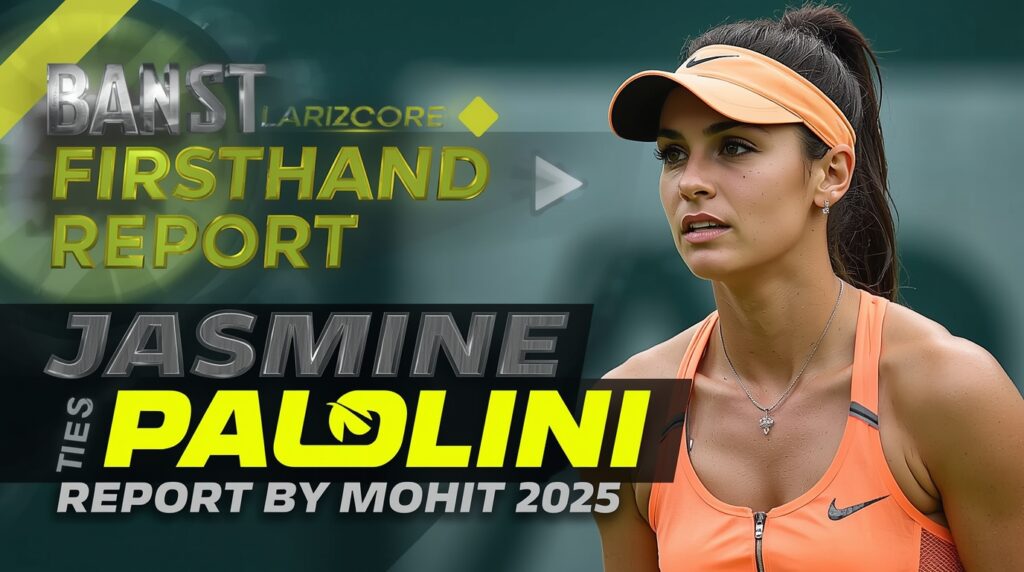
Jasmine Paolini Flashscore: A Firsthand Report by Mohit
The low hum of the crowd, the rhythmic pop of a tennis ball, the electric tension that hangs in the air before a crucial point—these are the moments I live for as a sports journalist. My name is Mohit, and for the better part of this season, my focus has been locked on one of the most compelling stories in tennis: the incredible rise of Jasmine Paolini. Standing courtside, notebook in hand, I’ve watched her transform from a talented contender into a genuine force on the WTA tour. This isn’t just about match results; it’s about witnessing the heart, grit, and tactical genius that numbers alone can’t capture.
For those of us who follow the sport with a passion that borders on obsession, staying on top of every serve, volley, and break point is critical.
That’s where my constant companion comes in. Tucked away on my phone screen is the one tool I trust to keep pace with the action, even when I can’t be at two matches at once. Keeping a close eye on the Jasmine Paolini Flashscore page has become a ritual. It’s more than just a stream of data; it’s a real-time narrative of her journey, providing the stats that give context to the drama unfolding before my very eyes. This report is a blend of what I’ve seen with my own two eyes and the data that backs it up, a firsthand account of a star’s ascent.

The View from the Sidelines: A Season of Breakthroughs
I remember the distinct feeling earlier this year, a buzz that started as a whisper and grew into a roar. It was clear something special was happening with Jasmine Paolini. She wasn’t just winning matches; she was dismantling opponents with a ferocious, all-court game that seemed to have found a new gear. From my vantage point near the player’s box, I could see the change in her demeanor. The confidence was palpable. She walked onto the court not hoping to win, but expecting to.
Her breakthrough at the Dubai Tennis Championships was a perfect example. I was there, feeling the desert heat, as she navigated a draw packed with top-tier talent. Match after match, she showed a level of consistency and power that left commentators and fellow journalists scrambling for superlatives. She wasn’t just hitting winners; she was constructing points with the precision of a master architect. Her footwork was relentless, her forehand a weapon she deployed with devastating accuracy, and her backhand, particularly down the line, was a thing of beauty.
Watching her triumph was one of those moments that reminds you why you love sports. It was the culmination of years of hard work, a player realizing her full potential on one of the biggest stages. That victory wasn’t a fluke. It was a statement. It announced her arrival in the upper echelon of the sport, and the shockwaves were felt throughout the tour. Players who might have overlooked her name in a draw were now taking serious notice.
The Clay Court Saga: Grit and Glory
As the tour transitioned to the iconic red clay of Europe, the questions began. Could Paolini translate her hard-court success to the slower, more demanding surface? Clay courts are the ultimate test of a player’s endurance, strategy, and mental fortitude. It’s a surface that exposes any weakness and rewards patience and tactical nuance.
I followed her to Rome, a city that breathes tennis during the Italian Open. The atmosphere was electric, especially for a homegrown talent. The weight of expectation from the Italian crowd was immense, but Paolini seemed to thrive on it. From my position in the press tribune, I watched her embrace the challenge. Her game, built on aggressive baseline play, adapted beautifully to the dirt. She wasn’t just hitting through her opponents; she was using the clay to her advantage, sliding into shots, using heavy topspin to push her rivals back, and mixing in delicate drop shots that died just over the net.
Her run at the French Open was nothing short of cinematic. I was there at Roland-Garros, surrounded by the ghosts of tennis legends, witnessing a modern fairytale unfold. Each round presented a new, tougher challenge, but Paolini met them all with that same steely resolve. Her matches became must-see events. I recall one particularly grueling three-set battle in the early rounds. The momentum shifted back and forth, and the tension was almost unbearable. From the press box, you could see the physical toll it was taking, but you could also see the fire in her eyes. She refused to be broken.
Her ability to dig deep in those critical moments, to find another gear when her body was screaming, was what set her apart. She wasn’t just a great shot-maker; she was a world-class competitor. Watching her fight for every single point, chasing down balls that seemed impossible to reach, was inspiring. It was a masterclass in heart and determination, and it won her legions of new fans, myself included.

Beyond the Baseline: The Tactical Mind of a Champion
Being this close to the action gives you an appreciation for the subtleties of the game that TV cameras often miss. It’s not just about the power of a forehand or the speed of a serve. It’s about the decision-making process under immense pressure, the ability to read an opponent, and the courage to change a losing strategy mid-match.
One thing that has stood out to me this season is Paolini’s court intelligence. I’ve seen her play opponents who tower over her, big servers who try to blast her off the court. But she never panics. She uses her speed and agility to turn defense into offense in the blink of an eye. She absorbs their power and redirects it with interest, often finding angles that leave her opponents flat-footed.
I was particularly impressed during a match against a top-10 player known for her powerful groundstrokes. For the first set, Paolini was on the defensive, pushed far behind the baseline. I could see her looking over at her coaching team, processing information, recalibrating. In the second set, she came out with a completely different game plan. She stood closer to the baseline, taking the ball on the rise and robbing her opponent of precious time. She started mixing in high, looping balls to disrupt her opponent’s rhythm, followed by flat, driving shots to the corners.
It was a brilliant tactical adjustment that completely turned the match on its head. She went from being dominated to dictating play. This is the kind of detail that doesn’t always show up on a simple scoreboard, but it’s the essence of what makes her such a formidable player. She thinks her way through matches, solving problems in real-time. This analytical approach, combined with her raw talent, is a potent combination that makes her a threat on any surface, against any style of player.
Data-Driven Dominance: Decoding the Flashscore Stats
The statistics from her incredible season paint a clear picture of an elite player. Let’s look at some key metrics. Her first-serve percentage has been consistently high, often hovering in the mid-to-high 60s, which is crucial for setting up points on her terms. But more importantly, her win percentage on her first serve is where she truly excels. It’s a testament to how effectively she uses her serve not just to start the point, but to gain an immediate advantage.
Another fascinating stat is her break-point conversion rate. This number is a direct measure of a player’s clutch performance. Paolini’s conversion rate has been remarkable. When she gets an opportunity to break her opponent’s serve, she seizes it. This reflects the aggressive, opportunistic mindset I’ve seen on the court. She applies relentless pressure during her return games, and the data proves it.
The head-to-head (H2H) records available on Flashscore are also incredibly insightful. Before a big match, I’ll study the H2H to see her history against her upcoming opponent. It provides context on past encounters, playing styles, and potential psychological edges. For instance, seeing a dominant H2H record can confirm that her game style simply matches up well against a particular player, giving her a mental advantage before a single ball is struck.
Finally, the match statistics section, with its point-by-point breakdowns, is a goldmine for a journalist. It allows me to pinpoint the exact moment a match turned. Was it a string of unforced errors? A run of incredible winners? A long, grueling game that broke an opponent’s will? The data provides the evidence, allowing me to craft a more accurate and detailed report. It transforms general feelings into concrete facts.
The Human Element: A Champion’s Character
For all the talk of stats and tactics, what truly resonates with fans—and with journalists like me—is the human story behind the athlete. Jasmine Paolini is not just a collection of impressive statistics; she is a charismatic and humble individual whose passion for the game is infectious.
I’ve had the chance to observe her in post-match press conferences, and her personality shines through. She is thoughtful in her answers, gracious in both victory and defeat, and possesses a wonderful sense of humor. She speaks with an honesty and authenticity that is refreshing. She doesn’t rely on clichés; she gives genuine insight into her mindset and her emotions on the court.
After her historic run at Roland-Garros, I was in the press room as she spoke about the journey. There was no arrogance, only a profound sense of gratitude and a bit of disbelief at her own success. She spoke about the hard work, the sacrifices, and the importance of her team. It was a moment of pure, unfiltered emotion. You could feel the entire room was captivated.
This humility and grounded nature make her incredibly easy to root for. Fans connect with athletes who feel real, who show vulnerability, and who appreciate the journey. Paolini has this quality in abundance. She smiles often, she engages with the crowd, and she plays with a joy that is evident to anyone watching. It’s this combination of ferocious competitor on the court and down-to-earth person off it that makes her such a complete and compelling figure in the world of sports.

Looking Ahead: The Grass-Court Challenge and Beyond
As the tour pivots to the manicured lawns of the grass-court season, a new chapter begins for Jasmine Paolini. Grass is a unique challenge. The low bounce and fast pace reward aggressive, first-strike tennis. It’s a surface that demands quick reactions, a potent serve, and a willingness to come to the net.
This will be another fascinating test of her adaptability. Can her all-court game, which has proven so effective on hard courts and clay, translate to the slick, green surface? From what I’ve seen of her athleticism and court sense, I believe she has the tools to be successful. Her ability to take the ball early and her quick footwork will be major assets. It will be interesting to see how she adjusts her strategy and shot selection for this new challenge. Her journey through tournaments like Wimbledon will be a key storyline to follow.
Beyond the immediate future, the sky is the limit for Paolini. She has proven she belongs among the world’s elite. She possesses the talent, the work ethic, and the mental toughness to compete for the biggest titles in the sport. Her journey is a powerful reminder that success is not an overnight phenomenon. It is the product of years of dedication, resilience in the face of setbacks, and an unwavering belief in oneself.
As a journalist, it has been a privilege to have a front-row seat to her phenomenal season. I will continue to be there, courtside, documenting her progress, analyzing her matches, and sharing her story. And I’ll have my trusted tool right there with me, keeping the Jasmine Paolini Flashscore page open to ensure every detail is captured. Her story is far from over. In fact, I have a feeling the most exciting chapters are yet to be written. The world of tennis is watching, and so am I.