







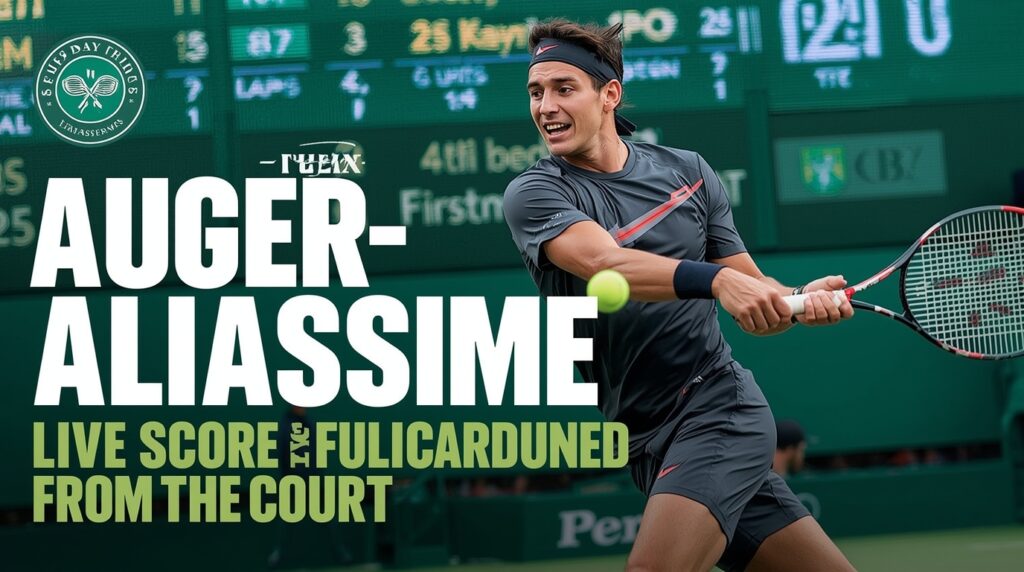
Felix Auger-Aliassime Live Score: A Firsthand Report from the Court
The air hangs thick with anticipation, a palpable energy that only a high-stakes tennis match can produce. From my vantage point just a few rows from the court, the world feels condensed to this 78-foot rectangle of hard-packed acrylic. I’m Mohit, and for years I’ve followed the careers of tennis’s elite, but today feels different. Today is about more than just a match; it’s about witnessing the grit and grace of one of the sport’s most compelling young talents: Félix Auger-Aliassime.
The roar of the crowd is a constant hum, a living entity that rises and falls with every swing of the racket. Digital scoreboards flash around the stadium, but the true story isn’t just in the numbers. It’s in the movement, the strategy, and the sheer force of will on display. People at home might be refreshing their screens for the Felix Auger-Aliassime live score, but here, we are living it.

The Opening Volley: Setting the Tone
The match begins, and from the first serve, Félix’s presence is undeniable. He moves with a fluid power that seems almost paradoxical. One moment he is a coiled spring of potential energy, his body low to the ground; the next, he explodes into a serve, the ball a yellow blur rocketing across the net. His opponent, a seasoned veteran with a tactical game, is ready for the challenge.
The first few games are a chess match. Rallies extend, each player probing for a weakness. You see Félix’s mind at work, his eyes constantly scanning, calculating angles and anticipating his opponent’s next move. He’s not just hitting a tennis ball; he’s solving a complex, high-speed puzzle. The sound of the ball off his strings is a sharp, clean thwack that echoes through the stadium, a testament to the purity of his technique.
I watch as he sets up for a forehand, his feet dancing into position. He unleashes a cross-court winner that paints the line, and a gasp ripples through my section of the crowd before erupting into applause. It’s moments like these that don’t translate to a simple score update. You have to be here to feel the collective intake of breath, to see the masterful shot land just inches inside the baseline.
Beyond the Scoreboard: The Mental Game
As the first set progresses, the physical battle intensifies, but it’s the mental fortitude that truly stands out. Tennis is a lonely sport. Out on the court, it’s just you, your opponent, and the immense pressure of the moment. I see Félix talking to himself between points, a quiet monologue of encouragement or tactical adjustment. He wipes the sweat from his brow, his gaze focused and intense, shutting out the thousands of eyes trained on him.
There’s a critical break point. The tension is a physical weight. A man next to me nervously taps his fingers on his knee. A woman in front has her hands clasped, her eyes wide. This single point could shift the momentum of the entire set. Félix takes a deep breath, bounces the ball three times—a familiar ritual—and then unleashes a serve that clips the line for an ace. The stadium erupts.
That single ace is more than just a point. It’s a statement. It’s a display of nerve under fire, a quality that separates the good from the great. Those following the Felix Auger-Aliassime live score from afar would see the game tick over in his favor, but they wouldn’t feel the release of tension that swept through the arena. They wouldn’t see the subtle clench of his fist, a small but powerful acknowledgment of a battle won.
This is the drama that box scores can never capture. It’s the human element of competition, the silent war waged between the ears. Félix has spoken openly about his work with sports psychologists, and from this close, you can see the fruits of that labor. He remains composed even when a call doesn’t go his way or when an unforced error costs him a point. He simply resets and focuses on the next ball, a discipline that is as impressive as his athletic talent.

A Masterclass in Modern Tennis
Watching Félix Auger-Aliassime play is like watching the evolution of tennis in real-time. He possesses the complete package of the modern player. His serve is a weapon, consistently hitting speeds that push his opponents back on their heels. It’s not just about power, though; it’s about placement. He mixes it up, hitting flat bombs down the T, kicking serves out wide, and slicing serves that skid low off the court.
His groundstrokes are equally formidable. The forehand is a heavy, topspin-laden shot that he can flatten out for a winner or loop high to push his opponent deep behind the baseline. I find myself mesmerized by the mechanics of it—the powerful rotation of his torso, the explosive uncoiling of his arm, and the elegant follow-through.
But it’s his backhand that often leaves me in awe. The two-hander is a model of efficiency and power. He can drive it down the line with incredible pace or roll it cross-court to open up the court. Several times during the match, he’s pinned in a corner, seemingly on the defensive, only to rip a backhand winner that turns the point on its head. The crowd responds with a collective roar of disbelief and admiration.
His net game is another crucial aspect of his arsenal. In an era dominated by baseline play, Félix is not afraid to move forward. He follows up aggressive groundstrokes by charging the net, his long limbs covering the space with surprising agility. His volleys are crisp and decisive, often ending points with a delicate touch or a powerful put-away. This all-court game keeps his opponents guessing and prevents them from finding any rhythm.
The Heart of a Champion
As the match stretches into a deciding set, the physical toll becomes evident. Both players are glistening with sweat, their movements slightly less explosive than they were two hours ago. This is where heart and conditioning take over. This is where champions are made.
Félix seems to dig deeper. You can see the determination etched on his face. Every point is a battle. He chases down balls that seem impossible to reach, stretching his body to its limits to send the ball back over the net. One particular rally has the entire stadium on its feet. It’s a grueling, 20-shot exchange that sees both players scrambling from side to side. It ends with Félix hitting a deft drop shot that dies just over the net, leaving his opponent stranded.
The ovation that follows is deafening. It’s not just for the point won, but for the effort, the raw desire. It’s a moment of pure sporting drama, the kind that gives you goosebumps. Fans are no longer just spectators; they are part of the experience, willing him on with their energy. For anyone tracking the Felix Auger-Aliassime live score, it was just one point, but for us here, it was a display of everything that makes him a special player.
He feeds off the crowd’s energy. A fist pump toward his player’s box, a quick glance at the roaring fans—these small gestures create a connection. He makes you feel like you’re in it with him. We ride the emotional rollercoaster of every point, feeling the frustration of a missed opportunity and the elation of a brilliant winner.
The Final Push to Victory
The final games are a blur of clutch serves and gutsy shot-making. The pressure is at its peak. Every serve, every return, carries the weight of the entire match. Félix steps up to the service line to serve for the match. The stadium falls into a hush. You could hear a pin drop.
He goes through his routine: a deep breath, three bounces of the ball. The first serve is a fault, just long. A collective groan murmurs through the crowd. The pressure doubles. On the second serve, he doesn’t hold back. He hits a heavy kick serve to his opponent’s backhand, forcing a weak return that sails into the net.
Match point.
Again, the silence. He tosses the ball up, his body uncoiling in a symphony of coordinated movement. The serve is an ace, right down the T. The explosion of sound is instantaneous and overwhelming. Félix raises his arms in triumph, a smile of relief and joy spreading across his face.
He walks to the net to shake his opponent’s hand, a sign of respect that is fundamental to the sport. Then, he turns to the crowd, applauding them as they applaud him. It’s a moment of shared victory. Those of us in the stands feel like we played a small part in it. Our cheers, our energy, our unwavering support—it all contributed to the atmosphere that fueled his performance.

A Journalist’s Reflection
As I gather my notes and make my way out of the stadium, the adrenaline of the match slowly begins to fade, replaced by a deep appreciation for what I’ve just witnessed. Checking the final statistics and scores is important for my report, but the numbers don’t tell the whole story. They can’t convey the emotional arc of the contest, the subtle shifts in momentum, or the sheer willpower on display.
Following the Felix Auger-Aliassime live score on a screen is convenient, but it’s a filtered experience. It strips away the context, the atmosphere, and the human drama. Being here, courtside, is to experience the sport in its purest form. It’s hearing the squeak of the shoes on the court, seeing the beads of sweat fly as a player strikes the ball, and feeling the collective energy of thousands of fans hanging on every point.
Félix Auger-Aliassime is more than just a collection of powerful shots and impressive statistics. He is a thoughtful, determined, and immensely talented athlete who carries himself with a maturity beyond his years. He represents the best of tennis: a combination of power, artistry, and sportsmanship.
Tonight, I wasn’t just a reporter covering a match. I was a fan, caught up in the magic of live sport. And as I file this report, I know that the numbers on the scoreboard are just a footnote. The real story was written on the court, in every powerful serve, every gritty rally, and every triumphant fist pump. It was a story of a young man on a journey, and we were all lucky enough to have a front-row seat. The latest check on the Felix Auger-Aliassime live score will simply say “win,” but those of us who were here know it was so much more.