





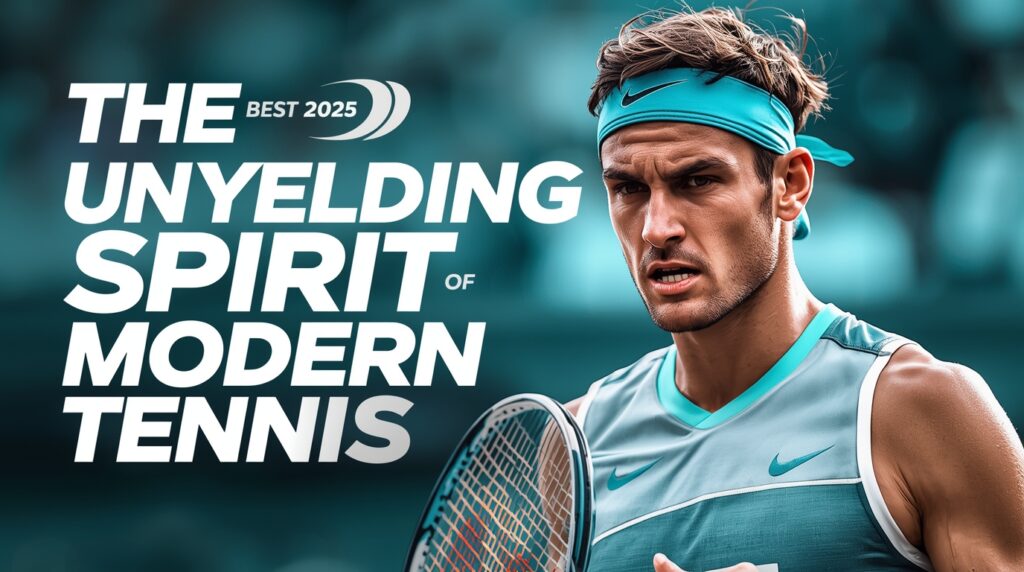
Alex de Minaur: The Unyielding Spirit of Modern Tennis
My name is Mohit, and I’ve spent the better part of my career courtside, watching the titans of tennis clash. I’ve felt the ground shake with the roar of the crowd at the US Open and seen the sheer will of athletes push them beyond their limits. But every so often, a player comes along who changes the way you see the game. For me, that player is Alex de Minaur.
It’s one thing to see him on television. It’s another entirely to be here, just feet from the baseline, and witness the relentless energy that defines him. The speed is the first thing that hits you. It’s not just quick; it’s a blur. He covers the court with an intensity that seems almost impossible to maintain, yet he does, point after point, game after game. I’m telling you, the camera doesn’t do it justice. You have to be here, feel the electricity in the air, to truly understand the phenomenon of the “Demon.”

The Making of the Demon
To appreciate the player he is today, you have to understand where he came from. Born in Sydney, Australia, to a Uruguayan father and a Spanish mother, Alex’s story is a global one. This multicultural background is woven into the fabric of his game—the grit and fight of the Australian spirit, combined with the clay-court craftiness of his Spanish upbringing. He spent his formative years training in Alicante, Spain, a decision that profoundly shaped his style.
Watching him, I see the fusion of these two worlds. There’s the classic Aussie “have a go” attitude, a willingness to chase down every single ball, no matter how lost the cause may seem. He forces opponents to hit one, two, even three extra shots to win a point. That pressure is immense. It’s a mental battle as much as a physical one. I’ve seen top-ranked players, guys known for their power and precision, start to fray at the edges, their frustration visible as another perfectly placed shot comes flying back over the net.
Then there’s the Spanish influence. His footwork is impeccable, a product of endless drills on the demanding red clay. He slides into shots on hard courts with an ease that few can replicate. This technical foundation gives him the balance and positioning to turn defense into offense in the blink of an eye. That’s the real magic of Alex de Minaur; he doesn’t just retrieve balls, he repositions himself to counter-punch with startling effect.
A Courtside Perspective on His Evolving Game
I remember watching him a few years ago. The story was always about his speed and his heart. Commentators would praise his defensive skills but often followed with a “but.” But can his serve hold up? But does he have the firepower to challenge the top five? Those were valid questions. From my vantage point today, I can tell you those questions are being answered.
The evolution of his game has been remarkable to witness firsthand. The serve, once a point of vulnerability, has become a weapon. There’s more pop, more confidence, and a smarter placement that keeps his opponents guessing. I was there for his match last season when he was down a break point, and instead of playing it safe, he ripped a high-kick serve out wide that caught his opponent completely off guard. It was a statement. It was the new Alex.
His forehand has also gained significant weight. He’s not just redirecting pace anymore; he’s generating it. He’s stepping into the court, taking the ball on the rise, and flattening out that shot to dictate rallies. This offensive mindset is the key to his ascent into the top tier of men’s tennis. He’s no longer just the counter-puncher; he is now the aggressor, a player who can control the tempo of a match from the very first strike. This tactical shift has made him a threat on all surfaces, not just the fast courts that traditionally favored his style.
The Mental Fortitude of a Champion
Beyond the technique and the speed, what truly sets Alex de Minaur apart is his mental game. Standing here, you can feel his unwavering focus. There’s no wasted energy between points, no theatrics aimed at the crowd or his opponent. It’s just pure, unadulterated concentration. His mantra, “Demon Mode,” isn’t just a catchy phrase; it’s a state of mind.
I had a chance to observe him during a practice session earlier this week. The intensity was the same as in a Grand Slam final. Every ball was chased, every drill executed with precision. His coach, Adolfo Gutierrez, wasn’t just feeding him balls; they were engaged in a deep, strategic dialogue. This dedication is what separates the good from the great. Tennis at this level is a year-round grind, and Alex’s work ethic is second to none. He embodies the idea that champions are made when no one is watching.
This mental toughness is most apparent in the big moments. I’ve seen him save a flurry of match points with a calmness that defies the pressure of the situation. He has an incredible ability to reset after a bad point or a lost set. While other players might let frustration spiral, Alex digs in deeper. It’s this resilience that has earned him the respect of his peers. When you hear players like Novak Djokovic or Carlos Alcaraz talk about him, they always mention his fighting spirit. They know that when you play Alex de Minaur, you’re in for a battle until the very last point.

More Than a Tennis Player
Off the court, the intensity gives way to a genuinely warm and humble personality. I’ve had a few brief interactions with him in the press room, and he’s always been gracious, articulate, and down-to-earth. He carries himself with a professionalism that belies his age. He understands his role as an ambassador for the sport and takes it seriously.
His relationship with fellow player Katie Boulter has also brought a different dimension to his public persona. It offers a glimpse into the life of a professional athlete, where balancing a demanding career with a personal life is a constant challenge. They are incredibly supportive of each other, often seen cheering from the stands during their respective matches. It humanizes him, reminding us that behind the “Demon” is a young man navigating the same complexities of life as the rest of us.
This relatability is a huge part of his appeal. Fans in the US and around the world see a player who leaves everything on the court, who respects his opponents, and who carries himself with integrity. He isn’t the tallest or the most powerful player on tour, but he proves that heart, speed, and intelligence can triumph over brute force. He is an inspiration for any young player who might not have been blessed with overwhelming physical gifts. His success is a testament to the power of hard work and unwavering self-belief.
The Rivalries That Define Him
Every great player is defined by their rivalries. For Alex de Minaur, his battles with the next generation of stars are shaping the future of men’s tennis. His matches against players like Jannik Sinner and Carlos Alcaraz are a fascinating clash of styles. Sinner’s clean, powerful ball-striking versus Alex’s relentless retrieving; Alcaraz’s unpredictable creativity against Alex’s structured, disciplined defense.
Being here for these encounters is a privilege. The speed of the rallies is breathtaking. These are not just baseline slugfests; they are high-speed chess matches where court positioning and shot selection are everything. When Alex plays these top guys, you can see him problem-solving in real-time. He’s constantly adjusting his tactics, looking for any small advantage, any crack in his opponent’s armor.
His breakthrough win over Rafael Nadal on clay was a watershed moment. To beat the undisputed King of Clay on his favorite surface was a clear signal that Alex had arrived. I was in the stadium that day, and the atmosphere was electric. You could see the belief growing in his eyes with every passing game. He wasn’t just competing; he was dictating play against a legend of the sport. That victory wasn’t just a win; it was a graduation. It announced to the world that Alex de Minaur is not just a top-10 player but a contender for the biggest titles in tennis.

What Lies Ahead
From my perspective here, watching him train for his next match, the future looks incredibly bright. He has broken into the ATP top 10, a goal he worked tirelessly to achieve. But if there’s one thing I’ve learned about Alex de Minaur, it’s that he is never satisfied. The top 10 is not the destination; it’s a milestone on a much longer journey.
The next logical step is a deep run at a Grand Slam. He has the game, the fitness, and the mentality to do it. The conditions at the US Open, with its fast courts and electric atmosphere, seem tailor-made for his style of play. The American crowds love a fighter, an underdog who punches above his weight, and Alex embodies that spirit perfectly. I can already imagine the roar of the crowd at Arthur Ashe Stadium as he chases down yet another impossible shot.
As I pack up my gear for the day, the sound of a tennis ball being struck with ferocious consistency still echoes from the court. It’s him, still out there, long after many others have called it a day. That’s the image that will stay with me. Not just the player who wins, but the player who works. Alex de Minaur is more than just a phenomenal athlete; he is the heart and soul of modern tennis, and it’s an honor to be here, watching his story unfold, one incredible point at a time.